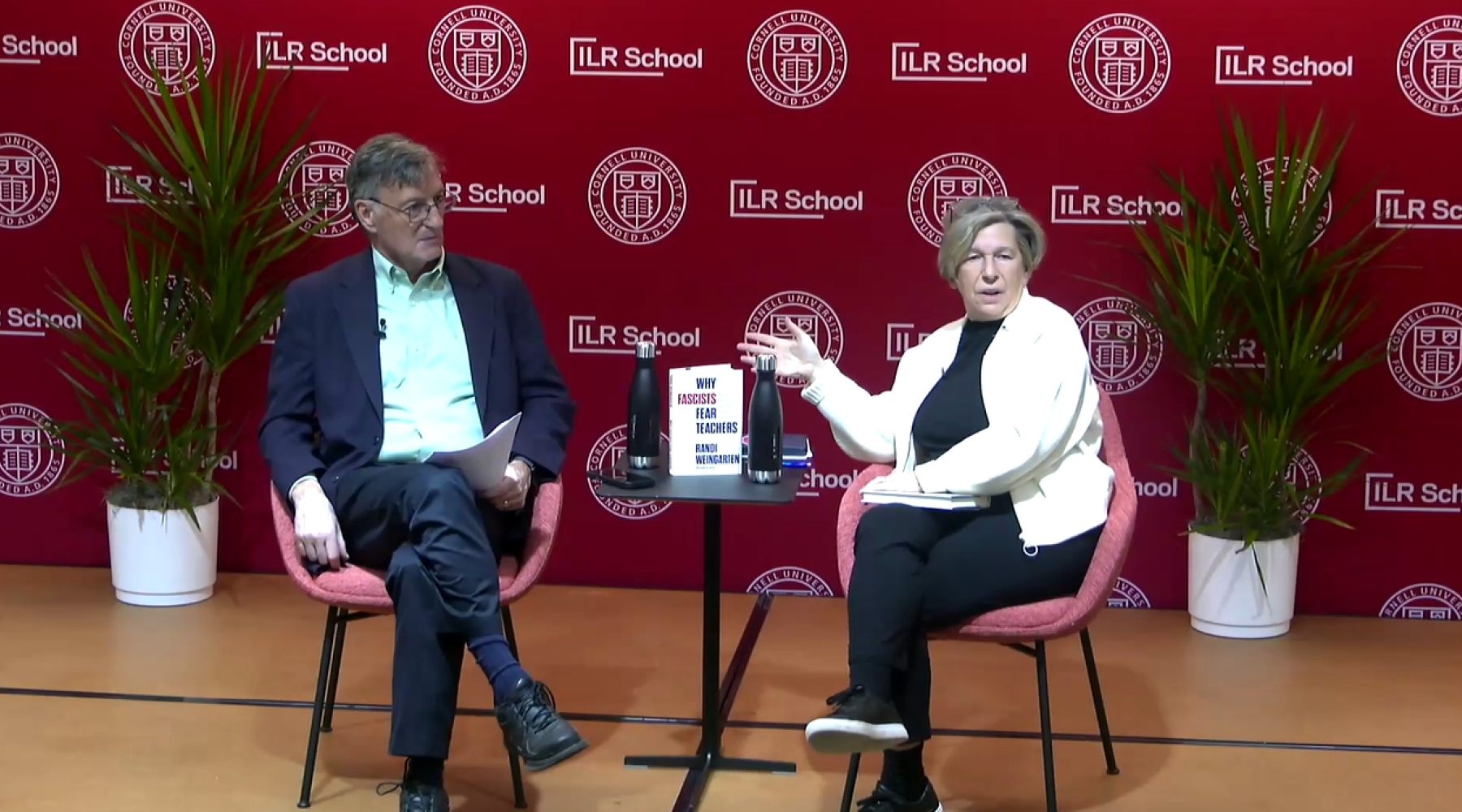
‘Why Fascists Fear Teachers’: Randi Weingarten '80 in Conversation with Steven Greenhouse
In November, Cornell ILR’s NYC office hosted AFT President Randi Weingarten '80 for a discussion about her new book, “Why Fascists Fear Teachers: Public Education and the Future of Democracy.”
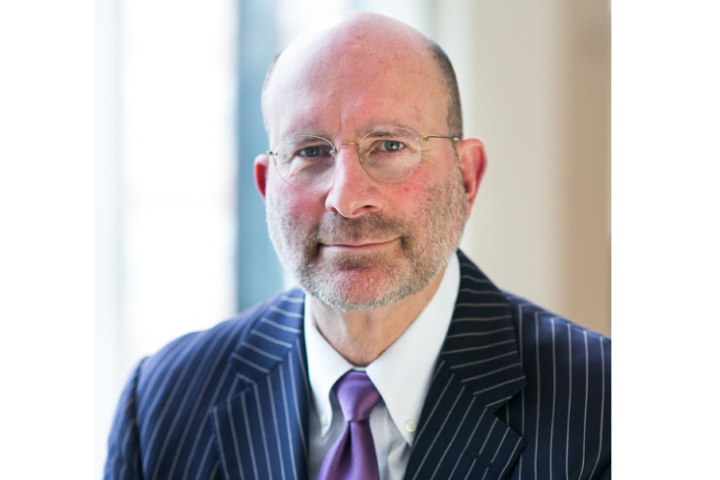
Moderated by former New York Times Labor Reporter Steven Greenhouse, the discussion delved into the book’s three main themes: honoring teachers, the importance of education and warning against fascistic tendencies. Weingarten spoke about the role of teachers in fostering democracy and countering dehumanization, as well as the impact of political narratives on education and the importance of community involvement in supporting public education.
Below are some highlights from the event’s discussion, which was co-sponsored by ILR’s Scheinman Institute; Worker Institute, Labor Leadership Initiatives; and the ILR Alumni Association's Labor Rights & Social Justice Council.
STEVEN GREENHOUSE
Why did you write this book?
RANDI WEINGARTEN
I wrote it for three reasons. The book that was in me was one that is a testament to school teachers and to what I have seen over the course of now my very long career representing teachers and being a teacher. I was really kind of sick and tired of the smears…Number two was what education is, and how it's needed more than ever in this moment. And so number two and number three kind of embody the title, which is why fascists fear teachers. Teachers are the foundation stone of democracy. They create the habits of democracy. If you are in a classroom on the first day of school, whether it's higher-ed or pre-K 12, you have a whole bunch of people who don't know each other walking into a classroom, and what does a teacher do? They take that diverse classroom and try to make it inclusive in a way that people get to know each other, communicate with each other in a way that is the basis of pluralism and democracy. And number three, it was a warning–and that's why the word ‘fascist’ is in the title. People didn't want to listen to the warning that Kamala Harris gave. They didn't want to listen to Joe Biden. They said it was all political. But here you had Harris, here you had [Mark] Milley and [John] Kelly, who had worked for Trump, saying that they're warning us about fascism and fascistic tendencies and fascistic behaviors. And during that election process, it was scoffed at as if it were just political. So I wrote it both as a warning and an antidote to the warning, [because that] is what education at its best, and particularly teachers, do. And then to really lift up teachers to try to defy the dehumanization that is so part of fascism, to try to defy that in so many ways.
STEVEN GREENHOUSE
You called your book ‘Why Fascists Fear Teachers.’ Wouldn't it be more correct to say that fascists fear a well-educated, well-informed public?
RANDI WEINGARTEN
Yes, exactly. They fear a well-educated, well-informed public, which is why they fear teachers, because the conduit to that well-educated, well-informed public are teachers. That's why they want to erase and basically undermine the public school project and the public school experiment. The Rufo quote in there–even though a lot of people said to me, don't put it in, you're just lifting him up–I wanted to put it in because I wanted people to understand who these folks are. Christopher Rufo, who is also the kind of architect at the Manhattan Institute for going after universities. He very clearly said at Hillsdale College a few years ago, ‘to create universal vouchers, or basically the fragmentation and the balkanization of public schooling, to end public schooling as we know it, you need to have universal public school distrust, and you need to be ruthless and brutal to do it.’ So they're smart enough to understand that you go after the vehicles by which you construct a well-educated electorate.
STEVEN GREENHOUSE
Then Secretary of State Mike Pompeo called you the most dangerous person in the world. So having attained that wonderful description, did you ever think, ‘Well, maybe I'm not the best person to be writing this book?’
RANDI WEINGARTEN
You know, that actually didn't cross my mind until you asked me that question. I think the smear is the point for them, and I think what we need to do–and Jeff Grabelski is in this room somewhere–I think that what you are teaching people, what the labor schools all across the country are teaching people, what many of the historians like Erica Chenoweth and Ruth Ben-Ghiat and Tim Snyder and Heather Cox Richardson are teaching people is that–as I see Karen ‘KC’ Wagner–we have to learn the lessons, frankly. The sit-down strike from the 1930s; we have to learn the lessons instead of being feared by all of this. There's not a rock that's big enough to hide under. We have to actually show up in community to fight it. It really is the people, not the politicians, who will fight it. If I were cowed by Pompeo, then I was actually making the mistake of my life. So if I want others to be out on the street, if we want others to be engaged in the fight back, to take our democracy back, and to not have the choice of either the cruelty of Trump or basically broken status quo, if we want others to do it, then I felt like I had to write it, and I had to show that I wasn't cowed by it.
STEVEN GREENHOUSE
In your book, you say, ‘I am not calling out fascists by name, but I'm calling out fascist behavior.’ Why, since [Mark] Milley and [John] Kelly called out someone as a fascist, why don't you call out individual fascists by name? And can you give examples of some of the fascistic behavior?
RANDI WEINGARTEN
Yes, so let me answer the first question and then the second question. I didn't call out, I didn't label anyone–it probably would have sold more books if I did–but I didn't want the whole conversation of the book to be ‘is he, or isn't he, or is she or isn't she?’ That is not my point. With all respect, that's not what a schoolteacher does if you're trying to teach critical thinking and the application of facts. The reason I think that Milley and Kelly were mocked is because people in the United States of America, maybe unless they went to Cornell or Harvard, unless they took Comparative Government–so they could have gone to CUNY, they could have gone to SUNY–But literally, most people in America have no idea what fascism is. And probably until this year or last year, had never used the words autocracy or autocrats…There is a huge difference between just having a political discussion, where there's just mere insults, versus the degradation to the dehumanization to such a point that it justifies violence against the Other. And people don't understand it, because we're so far away from World War Two, and frankly, we're so far away from the lynchings in the south–that was fascism, but we're so far away from it! I'm not saying that people are not struggling, struggling with, you know, ‘Can we have a vacation, and, you know, buy a home? Can we make sure that we can pay for our health insurance?’ The affordability crises are real, but it is really different than dehumanizing the Other to such an extent that you justify violence, and that's fascism.
STEVEN GREENHOUSE
Why are we seeing so many attacks now against teachers and teachers' unions? I remember it started in 1996 with Bob Dole at the Republican Convention. But, you know, some people say it's because the teachers union supports Democrats, but it's much more than that, right?
RANDI WEINGARTEN
It's because of what Rufo said. It's because they want to end the public education experiment and project as we know it. The people who are in charge right now, or the people who want to be in charge–when I said they want to go back to the Gilded Age, Tim Snyder said to me, ‘Oh no, it's the de-enlightenment. They actually want to go back to before enlightenment.’ There's a group of people who actually believe that, you know, they should be in power, and they should have that kind of power and prestige, and they don't actually want to share. And so the key is having a society that works, that's not tribal, that doesn't descend into division and despair. There are three ways that people, regular people, have power in the country, and one is a system of public education. Now, where I depart from some of my colleagues is that I think we have to strengthen it. I don't think we should actually just say, ‘Let's protect public education.’ We have to strengthen it. We have to make it better. We have to not only say, but believe in equal opportunity for all, opportunity for each and every student, but education is the foundation stone to pluralism and labor is the foundation stone to regular folks having a pathway to opportunity for their families. The same people that undermine education and public education completely attack labor as well…Part of what I did in this book is I'm not asking you to agree with me. I'm asking you to try on this theory. I'm asking you to just go with me through these chapters, to think about whether this theory holds water. This is part of who we are as teachers, and part of what I hate about the erasure, and part of what I hate about the censorship, is we are actually starting to restrict people in terms of what they learn and seeing the context or seeing different things, trying something out. We have an obligation to teach kids how to think, not what to think. And as a teacher, there's a difference between being a teacher and being an activist. And as a teacher in a classroom, I want to make sure the kids have all the tools they need so they can navigate their own lives. As an activist outside of the classroom, I want to fight for labor rights and health care rights and decent wages and all of that. Those are two different fights.
STEVEN GREENHOUSE
Donald Trump, in his attacks on teachers, on education, has made fighting against DEI one of his central themes. What do you think of Trump's war against DEI, and what do you think about how he has used it against public schools, against teachers, against universities and what could and should be done about that?
RANDI WEINGARTEN
It is part of a playbook that tries to construct an us versus them, and the ‘them’ in this instance is the 50 to 100 years of trying to create equality in this country. So they find a term; this time, it's DEI. I mean, think about it, diversity, equity and inclusion. Diversity, has made, has been the way in which the country has become great and innovative. How many times had even Ronald Reagan talked about how immigration was our strength, but in this era of America first, it's trying to go back to a mythical past that says diversity is a problem, not a benefit. Same in terms of inclusion, same in terms of equity. It is basically trying to rewrite and say that the last 75 years, since Brown in the aftermath of World War Two, a fight for equality between basically folks of color and folks who are white, that that fight was a wrong fight, and he's using the words DEI and making it toxic to try and undermine the fight for equality.
STEVEN GREENHOUSE
I don't doubt that millions and millions of Americans agree with you that it's that these attacks on teachers, these attacks on public education, these attacks on teachers' unions, are wrong. What can parents, what can students do to fight to protect education and to back teachers?
RANDI WEINGARTEN
So first and foremost, be in community with a local school. It is really important to go local in this moment, as opposed to going national. Less than 30% of adults in America right now have kids in school, which means that you don't have the kind of support that one needs in terms of local schools. And so being a volunteer, doing something about public education, supporting teachers in some way, being, you know, with a PTA, being with parents together–Red Wine and Blue has all sorts of different chapters, so does Moms Rising. There's lots of different groups that you can be part of that help students and young people and schools. That, to me, is the most important thing, other than voting. But the second piece is, we need to get people out to support public education as we know it. So in a school board election, go to a school board. Support the school board candidates, support a levy, not blindly. Like, make sure that we're using the money wisely. We have to find ways that people feel confidence in terms of public education. And then third is ultimately voting. But I would actually say take one issue of so many–and my wife says this a lot, and I think she's right–None of us can do everything, but we all can do something. Maybe it's a food pantry at a school. Maybe it's the wraparound services that we're trying to do at schools. Maybe it's a tutoring program. I have an idea that in any school system, we should get the adults in a community to mentor ninth graders or 10th graders, and have every single ninth grader have a mentor from somebody in the community. So you start seeing children and young people, other people's children, as somebody who's important and real. That's my idea, but there's a whole load of ideas. Just get involved, because the politicians are not going to solve this for us. It's the people who are going to either win back our democracy and then try to make a better life, or we're not.